

Sometimes the truth is simply: This is too much. Period. Full sentence. Too many priorities can be real. Not enough capacity can be real. Competing demands can be real. The deadline can be ridiculous. The client can change the scope. The expectation may genuinely not be achievable all at the same time. I want to start there because there is a version of personal development that takes an objectively impossible workload and somehow turns it into your mindset problem. You're overwhelmed? Set better boundaries. You're exhausted? Practice gratitude. You can't possibly get everything done? Maybe you need to become more resilient. No. Sometimes the workload is the problem. Naming that is not negativity. It is diagnosis. And my big burning belief is that we need to figure out what's actually going on before we jump into action.
Start With What Is Actually True
I recently spoke to a group working inside a fast-paced, high-performance organization, and one phrase came up more than once: Everything is a priority. If everything is a priority, you are constantly deciding what gets your attention first. That creates real pressure. You do not need me to convince you that the pace is imaginary. The useful question is not: How do I convince myself this is fine? It is: What belongs to the situation? Maybe the timeline is too short. Maybe the team is understaffed. Maybe the client changed the scope. Maybe three different people are asking for three different things. Maybe there is objectively more work than can fit into the hours available. Good. Now we are telling the truth. Because you cannot make a good decision from a lie.
Then Ask What You Are Adding
The workload can be real, and we can still add another layer on top of it. I can't disappoint anyone. I should be able to handle this. I can't ask for help. I can't get this wrong. If I say I don't have capacity, they'll think I can't do my job. Someone else would be able to figure this out. I need to prove that I can do all of it. Now you are not just doing the work. You are doing the work while also managing the story about what the work says about you. That second job is exhausting. This is the part people miss when they talk about burnout. We collapse the whole thing into one sentence: Work is crazy. But "work is crazy" can contain two very different problems. There can be a real problem in the environment. And there can be the meaning you are making about yourself inside that environment. Those are not the same thing. They may need completely different solutions. This is also where capability can quietly become obligation. A lot of high performers are extremely good at making impossible things happen. They figure it out. They stay late. They cover the gap. They anticipate the issue. They fix the mistake. They make sure the client never feels the mess behind the scenes. And because they are good at it, everyone lets them. Including them. Eventually: I can handle this quietly becomes: I have to handle this. The answer is not to become less capable. It is to get your choice back. Just because you can carry it does not mean it belongs to you.
Where Do You Actually Have Choice?
This is the question I care about most: What belongs to the situation? What belongs to me? Where do I actually have choice? Maybe you do not control the deadline. Maybe you do not control the number. Maybe the client really did change the scope. Maybe your company moves at New York speed and nobody is slowing down because you would like a quieter week. Fine. Where do you still have choice? Can you raise your hand? Can you say, "I can absolutely add that. Which of these other priorities should move?" Can you ask for the definition of success before you start sprinting? Can you say, "I want to make sure I can deliver this well. Let me check my resources and come back to you." Can you communicate before the deadline instead of silently trying to make the impossible possible? Can you stop assuming that asking for help is proof you failed? There is a strange belief in a lot of high-performance environments that saying, "I cannot do all of this at once," is somehow less professional than saying yes, panicking privately, resenting everyone involved, and missing the expectation five days later. I do not buy that. There is enormous power in saying: Here is what is on my plate. Here is what I can do. Here is what I cannot do with the current variables. What do we want to change? That is not weakness. That is information. And information gives everyone more agency. Your manager gets to choose. Your client gets to choose. Your team gets to choose. You get to choose. That is control. Not controlling the client. Not controlling the workload. Not controlling your boss. Not controlling whether somebody is disappointed. Control is knowing where your choice still lives.
Want to explore how these structures operate in your own professional and personal life? The Babcock Method is designed to uncover and rewrite these cycles.


The Worst Time to Find Your Confidence Is When You Need It Most
Confidence is easy when things are going well. The real test is what it's built on when the evidence disappears. Here's why waiting for proof before you feel confident has it backwards.
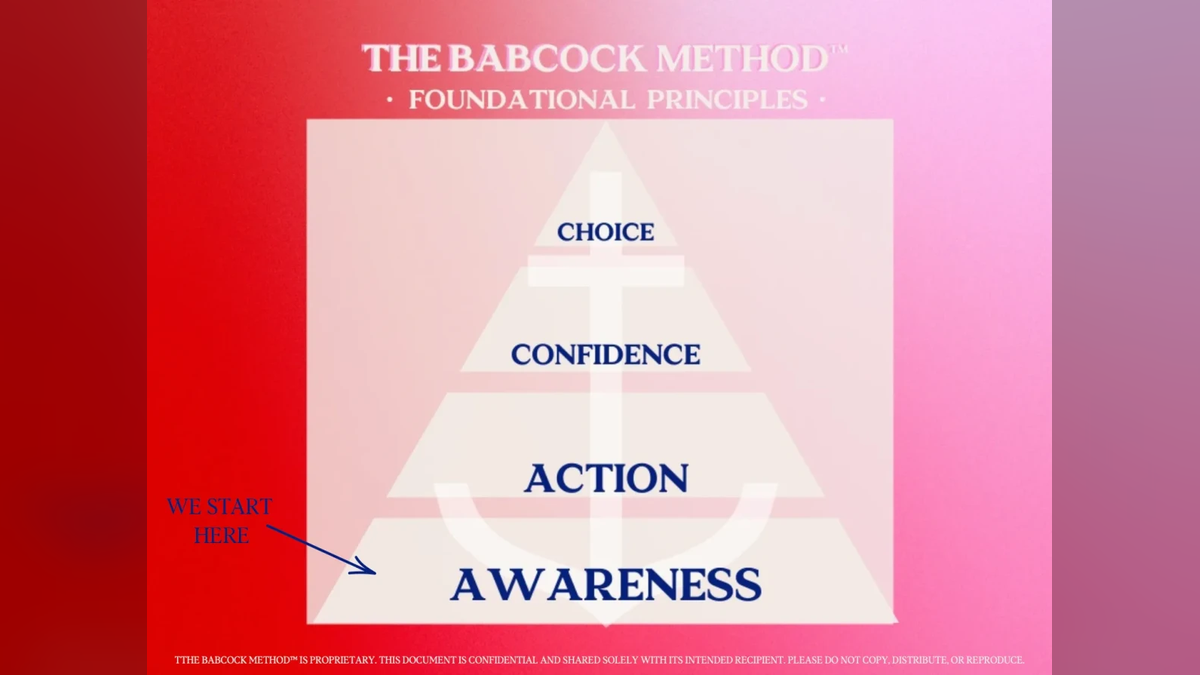
Stop. You're Doing it Wrong.
You feel stuck, so you take action: new job, new relationship, new plan. But action isn't the same thing as progress. Here's why the fastest way to actually change your life starts with the one step almost everyone skips.
Start with diagnosis
This is where clarity
begins.
If you’re done performing and ready to see what’s actually there.
The Discovery Call is the right place to start.
©2026, Rebecca Babcock Coaching.