
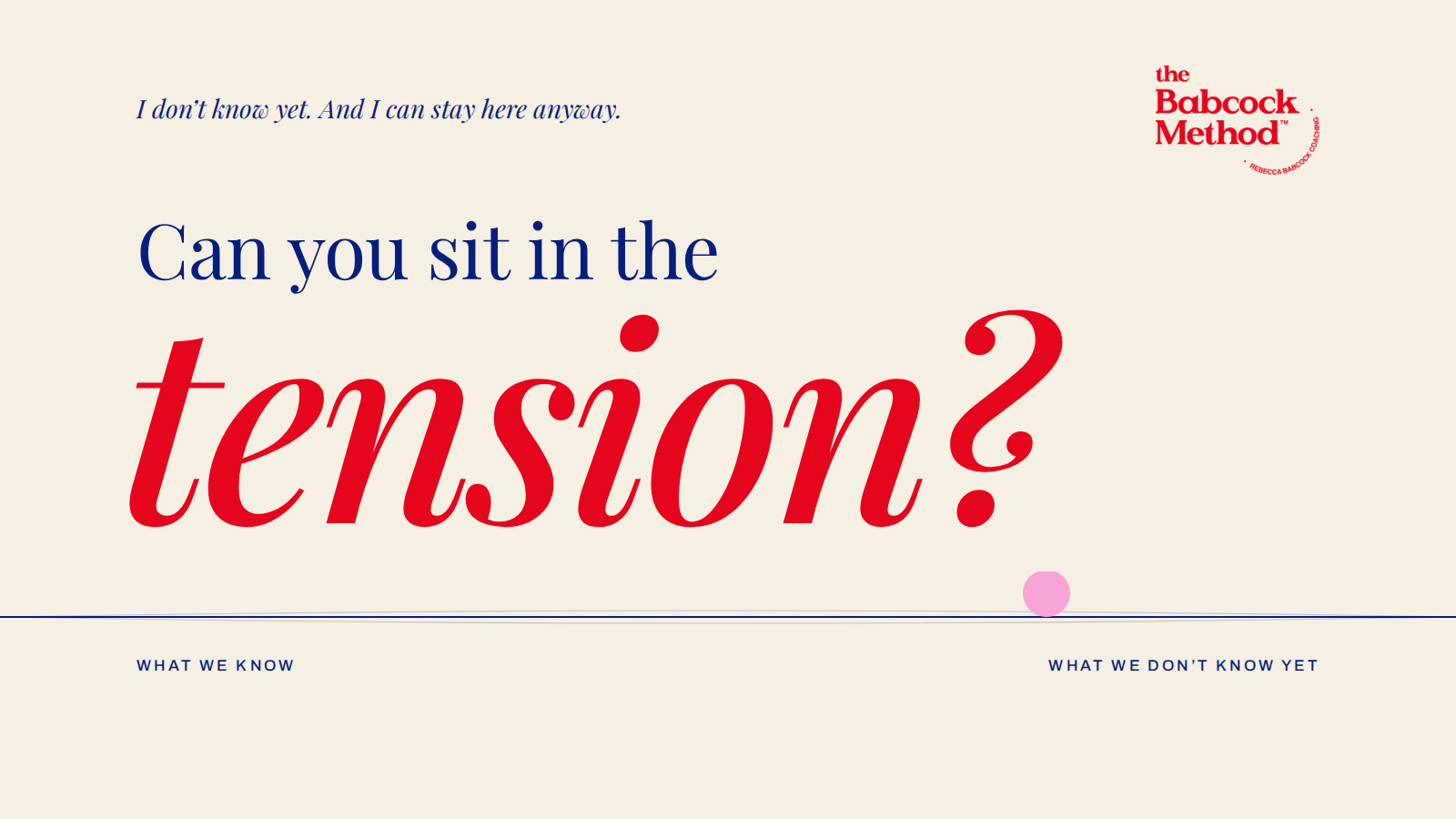
Most of us don't lose ourselves when something goes wrong. We lose ourselves when we don't know what happens next. Will the opportunity work out? Will the person we're counting on come through? Did we make the right decision? Will the number come in? That gap between what we know and what we want to know is tension. In a recent Babcock Method Leadership Mastermind, we started out talking about connection and flow, and ended up somewhere bigger: what if connection is the ability to stay present in the tension of not knowing?
What We Do When We Don't Know
When uncertainty gets uncomfortable, we reach for a familiar exit. We overprepare, people-please, overperform, procrastinate or control. We replay conversations and script the future in our heads. Sometimes it even looks like productivity. One leader in the group was handed a big new set of responsibilities by the owner of his company. What he heard was: He must think I'm not doing enough. Later he listened back to the conversation and heard something else entirely. His boss trusted him and believed he could handle it. The event hadn't changed. The story had.
What Do You Know, and What Have You Added?
Our brains hate an incomplete story, so we fill in the blanks. Rarely with "I'm sure it's fine." Usually with the story closest to our fear: They're disappointed. I'm not doing enough. I have to fix this now. In my coaching I call that voice the gremlin, the protective narrative convinced its job is to keep us safe. We all have one, and it gets loudest in the space between what we know and what we don't know yet. Before long, we're responding to the story we've built, not to what actually happened.
Presence Is Not Passivity
Sitting in the tension doesn't mean sitting on the couch waiting for the universe to handle your career. Action matters. Goals matter. Some people in the group described flow as movement, being fully immersed in the work. Others described stillness, even something as ordinary as washing the dishes. One member shared a Gaelic idea he translated as "stillness without loneliness." What connected them all was presence. So the question isn't "Am I taking action?" It's "Where is my action coming from?" There's a difference between momentum and panic disguised as productivity.
What Comes Back When Fear Isn't Driving
I asked the group what they lose access to when the gremlin takes over. One person said, "Everything." So we flipped it. What becomes available when fear isn't driving? Intuition. Trust. Clarity. Empathy. Gratitude. Our values. Nobody said "I get smarter" or "I work harder." Everything they named was something they already had. Maybe connection to ourselves isn't about finding what's missing. Maybe it's about staying connected to who we already are when fear gets loud.
Goal or Trajectory?
Clay Boykin, a coach on my team, captured this in what he calls a Q-Cross. A goal invites a binary question: did I hit it or miss it? Trajectory asks something different: am I moving in the direction I want to go? That creates room for perspective, for becoming, and for time. As Clay put it, living in the tension gives time a chance to do its work. New information arrives. Circumstances change. Sometimes "let's see how this unfolds" isn't avoidance. It's a decision.
Holding Both
Clay also brought in the idea of holding the tension of opposites. So much of what we try to escape comes from believing only one thing can be true. But someone can be a wonderful person and not the right fit for the role. I can want an opportunity badly and accept that I can't control whether I get it. I can be afraid and still refuse to let fear make the decision. Maturity isn't always resolving the contradiction quickly. Sometimes it's letting two things be true long enough for something else to emerge. Section 7 Heading: How to Practice Notice the urge to escape. Name the story. Separate what you know from what you've added. Pause before you react. Then try Clay's simplest tool: "I'm curious." I'm curious what they meant. I'm curious why this is hitting me so hard. I'm curious what happens if I don't solve this today. Curiosity sees possibilities fear can't. Uncertainty isn't going anywhere. So maybe the practice is simple, and hard: I don't know yet. I don't particularly like not knowing. And I can stay here anyway.
Want to explore how these structures operate in your own professional and personal life? The Babcock Method is designed to uncover and rewrite these cycles.


When the Workload Really Is Too Much
Sometimes the workload really is too much. The work is not pretending otherwise. It is separating what belongs to the situation, what belongs to you, and where you still have choice.
The Worst Time to Find Your Confidence Is When You Need It Most
Confidence is easy when things are going well. The real test is what it's built on when the evidence disappears. Here's why waiting for proof before you feel confident has it backwards.
Start with diagnosis
This is where clarity
begins.
If you’re done performing and ready to see what’s actually there.
The Discovery Call is the right place to start.
©2026, Rebecca Babcock Coaching.